USED Mesa Boogie Mark V Head
USED Mesa Boogie Mark V Head
Couldn't load pickup availability
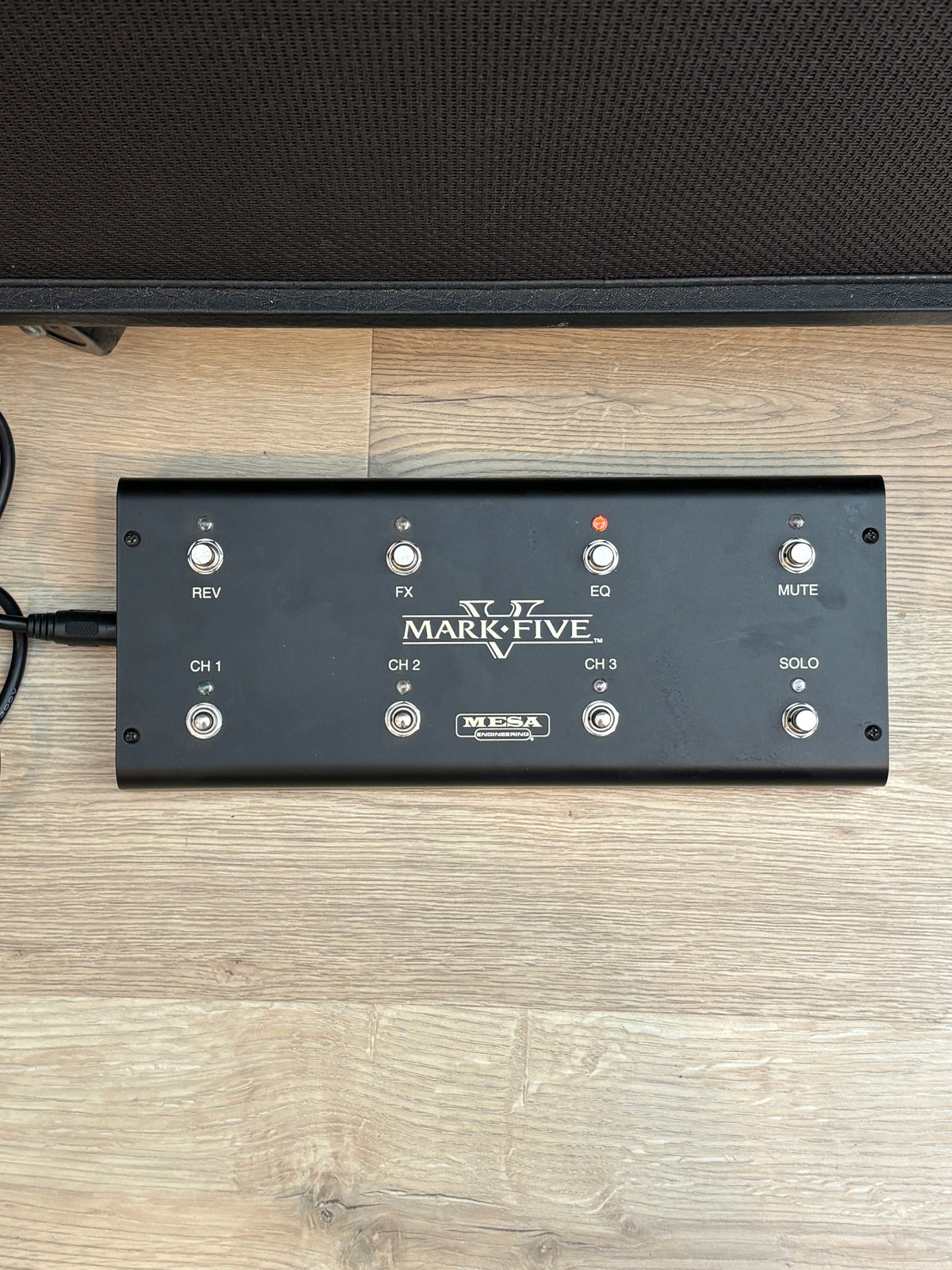
Includes Footswitch and cable
The 90W Mesa Boogie Mark V Medium Tube Guitar Amp Head is more than a collection of amplifiers. It's a living history of Mesa Boogie's contributions and a tribute to the evolution of electric guitar tone. Over 40 years of designing high-performance tube amps were put to the test to get this much tone under one roof and keep it easy to dial.
They're all here: the Mesa Boogie Mark I, IIC+, IV, all of them are recreated faithfully from decades of refinement. Many are saying they're better than the originals. More than a Greatest Hits package, though, you'll also find some new Brit-inspired circuits in the Mesa Mark V amp head that rival classic Boogie sounds.
Preamp
Three distinct Channels present the footswitchable sounds in a simple-to-dial platform. Each preamp Channel contains 3 distinct Modes that are controlled by a simple mini-toggle Mode switch found in the upper left corner of each channel. This switch controls the voicing of each channel. In some cases these voicings are related by style and give you important musical differences within a gain structure and sonic theme. In other cases, both gain and EQ are radically altered to achieve drastically different sounds”yet these sounds appear on the same set of controls. This is a result of needing a certain circuit architecture and Tone control string to achieve a particular sound style. Sometimes these extreme mode differences require different Gain and Tone control treatments to achieve a recognizable and iconic sound. In other words, it may require some dialing of the controls when you are touring through the modes, but you will quickly learn to choose a mode and dial it up to your needs in seconds.
Channel I contains the lowest gain sounds of the three Channels and can be thought of as the Rhythm or Clean channel. The other two channels contain modes that work better for soft clip, medium crunch and high gain rhythm work. Channel 2 is the transitional channel between the low gain sounds of Channel 1 and the high gain fury of Channel 3, to encompass the best of the Mark Series Overdrive sounds. Beginning with the MK II C+ (switch up) the sound is pure, blistering focus and this is the classic Boogie voice of the 80's that became the foundation for many staple players in the rock industry. The classic V curve on the Graphic EQ became an integral part of this sound and went on to be the sound of choice for some of the hardest hitting Punk and Hardcore bands of the '90s and 2000s and is still currently used by many top acts. The original II Cs bring many times their original selling price, and this faithful recreation of that burning sound is the cornerstone of Channel 3.
Equalizer
The on-board 5-band graphic EQ has been an iconic trademark of Mark Series Boogies since they first appeared on the Mark I back in 1970. While the Mark V tone controls are accurate and effective over a wide range, they come earlier in the signal chain and can only achieve so much shaping before they produce possible imbalances in certain Modes. The Graphic EQ comes at the very end of the signal chain so you can shape the final sound with the only consideration being how much of a certain frequency your speakers, cabinets (and ultimately your ears) can handle.
Multi-Watt Power
The bottom 3-position mini toggle in each channel is the Multi-Watt power feature that determines the amount (wattage) and type (configuration) of power each preamp channel will be coupled with to create a classic sound. Any amplifier's sound is 50% preamp and 50% power, and this switch is responsible for a large part of a given channel's personality and feel. The choices repeat for all 3 Channels and they are comprised of 90-, 45-, and 10-watt settings.
Simul-Class Power
One pair of output tubes is wired in the more efficient, cooler running Class A/B Pentode configuration, which produces the greater portion of power and headroom while running cooler. This was the popular way of wiring amplifiers from about the early '60s forward. The only sonic penalty for its greater power is that it can have a tendency to bring forward the harsher odd-order harmonic content. The Simul solution; add a pair of tubes running in the less efficient, but infinitely sweeter Class A Triode configuration. This style of wiring produces far less power out of a pair of tubes while creating more heat, but it emphasizes sweeter harmonics and transitions to clip with a soft, rich purring quality like no other.
The Mark V presents you with two ways to utilize this power. 90 watts combines the two wiring styles to deliver the maximum power and headroom. It is substantially sweeter and warmer, and is little more scooped than a standard 100 Watt amp, yet with plenty of punch and authority. 45 watts shuts down the middle pair of output tubes wired in Class AB and allows you to operate the output section in just the Class A mode for a perfect lower wattage range that clips sweeter and earlier, and yet is still plenty powerful enough to play out in medium sized venues.
Combining these two opposite styles of wiring in one amplifier gives you the best of vintage and modern amplifier styles. Headroom and power are there when you need it, while Simul feels inspired.
And finally, the Multi-Watt feature allows you to switch down to 10 watts of pure Class A Triode, and capture the essence of the best vintage circuits. Here, the 2nd Harmonic (an octave above the note played) is allowed to pass freely through the circuit, putting a magical halo around the notes that shines and rings with beyond-vintage soul.
These three power choices give you ultimate flexibility as to the styles and venues the Mark V can adapt. And when you combine the power of the separate Preamp Channels, the combinations of EQ and the Power options, you have Mesa Boogie's most comprehensive collection of tube amplifiers ever brought together in one chassis.
Output and Solo
These two controls handle the overall output (volume) level of the Mark V when the Effects Loop switch on the Rear Panel is switched into the FX Active (switch up) position. With the Effects Loop in the Hard Bypass (switch down) position the Output and Solo are inactive and the overall volume levels will be determined by the Master control in the Channels.
The Output control enables you to raise and lower the entire playing level of the Mark V without affecting the balance you have set between the Channels with the Channel Master.
Overview: Rear Panel
A four-position Channel Select rotary control is provided to access the 3 Channels when the Footswitch is not connected (in the studio) or available. Simply select which Channels you wish to play, when the footswitch is not in use. Select the position to the far right (when facing Rear Panel) labeled "FTSW" and insert the DIN connecter on the Footswitch Cable into the Foot Switch jack on the right side of the Rear Panel.
A five-position rotary Loop Assign switch is provided to assign the Effects Loop to any or all of the Channels or, select FTSW to trigger the Loop on and off with the Mark V Footswitch. The Effects Loop must be in the FX Active position for the Loop Assign rotary to function.
Four 1/4" External Switching phono jacks are provided for remote control of the Mark V Channels, EQ and Solo control from a master switcher. This feature is extremely important if the Mark V is to be used in a live stage set-up where all amplifiers and processors are controlled under one keystroke from a programmable master switching device.
The Effects Loop is fitted with a Hard Bypass feature that removes a whole tube (two stages) and all associated circuitry from the signal path for the purist who insists the most direct path to tone in the studio. When the Effects Loop is activated an adjustable Send Level control assures optimum performance with your processing devices.
Individual Reverb controls for each Channel allow you to set the desired mix of the rich all-tube Reverb effect for each Channel without compromise. The Reverb effect can be taken in and out of the signal path with the Rev button on the Mark V Footswitch.
A Pentode / Triode mini toggle switch allows you to choose the wiring configuration of the middle pair of power tubes in Channel 3 only. Pentode produces a bolder, tighter voice that has a more pronounced midrange curve and is excellent for adding percussive authority to lower gain single note solo sounds. Triode softens the attack and scoops the mids a bit to create a more liquid, legato feel that really shines for high gain styles and faster playing.
Two 8-Ohm and two 4-Ohm Speaker Outputs are provided. With these jacks almost any speaker cabinet configuration can be accommodated. An 8-Ohm load will produce the punchiest, tightest sound and the maximum headroom.
A 1/4" Tuner Output is provided and a Silent Tuning feature has been incorporated so you can tune the instrument onstage without bothering the band or audience. Simply connect your favorite tuner and tap the Tune button on the Mark V Footswitch and all sound to the Speaker Outputs is muted.
A Slave Output and Slave Level Control allows you to capture the full sound of the Mark V, both preamp and power section, for a feed to processing racks and/or additional power amps (perhaps Mesa Stereo Rack power) for big venue applications.
The amp's Cooling Fan is fitted with an On/Off switch to allow silent running in the studio or late night practicing in the lower wattage settings. Finally a Bias Select switch is included that allows you to run EL34 power tubes in place of the stock compliment of 6L6's. You can run EL34's in just the outside pair or all four power tube spots. The EL34 style tubes will produce a brighter, skinnier sound that will clip with a whole different harmonic content that can be nice, especially for recording where you may not need the Channel switching performance of all three Channels and can dedicate the amplifier to one specific sound. The 6L6'S will most likely perform better for a wide range of sounds and certainly sound fatter and richer on most all the sounds and produce the greatest clean headroom. Whichever tubes you prefer, make sure the setting of the bias switch matches the tubes in use.
Share